
By Dr. Syeda Sultana Rizvi
The EU Life sponsored project AskREACH that deals with providing information on presence of harmful substances in the products can boast of achieving a milestone by developing a free mobile phone application called scan4chem, that helps consumers in checking the presence of hazardous substances, if any, in articles they are going to buy. Still, a focus on more effective mechanisms of communications is needed for the awareness of all the stakeholders and to optimize the use of this application.
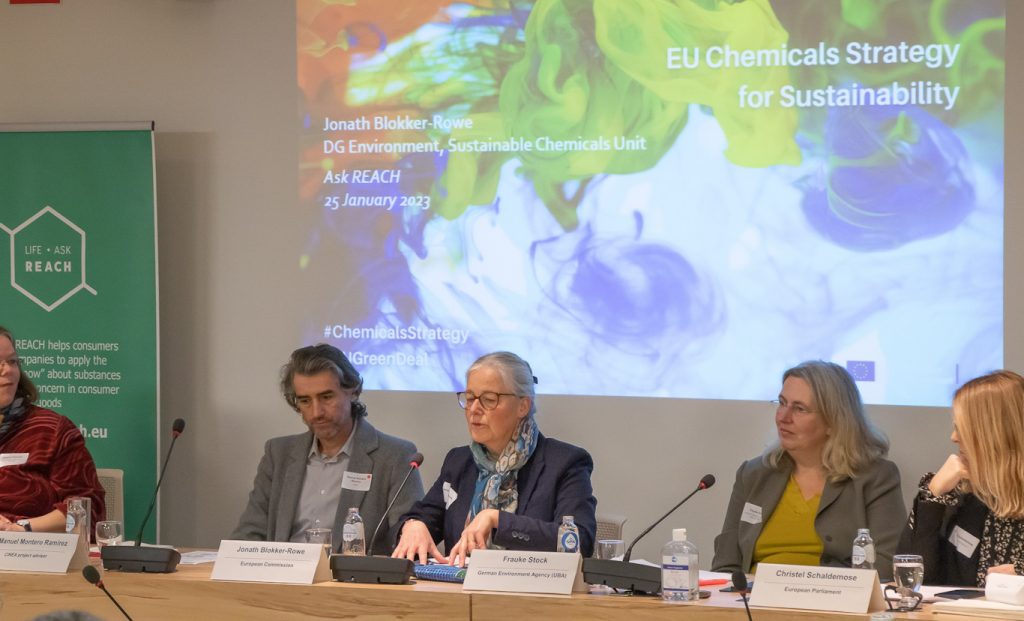
A view of final meeting of the AskREACH project. Brussels 25 January 2023.
Almost reaching the stage of completion, AskREACH, a project pertaining to the European Union’s legislation on Registration, Evaluation, Authorisation, and Restriction of Chemicals (REACH) has finished an uphill task of creating a dynamic database of harmful substances or Substances of Very High Concern (SVHCs) found in the articles of common use and linking it to a free smartphone application. Thus, enabling consumers to find out by scanning bar code of the product, whether the article in question contains harmful SVHCs or not.
Many of us may not be aware that very harmful substances or SVHCs can be found in articles of everyday use. You would be surprised to know that a number of such things may be right there in our diet and other articles around us, such as packaged and processed food; cooking utensils; textiles furniture; electronic goods such as computers; construction material; and even some of the plastic toys and soothers of children. Frightening! isn’t it?
The majority of consumers have little knowledge about scientifically proven facts that SHVCs can cause cancers, disturb hormonal system, and affect reproductive health, among many other harmful effects. Having toxic properties, SVHCs can continue to persist for long time spans in the environment thus proliferating toxicity in many ways.
European Union’s legislation on, Registration Evaluation, Authorisation and Restriction of Chemicals (REACH) came into force in 2007 in response to the situation that a large number of articles in the European market contain hazardous substances, at times, in very high amounts, and yet insufficient information on the hazards that they may pose to human health and the environment.
REACH addresses the production and use of chemical substances, and their potential impacts on both human health and the environment. It aims at protecting human health and the environment through the better and earlier identification of the intrinsic properties of chemical substances.
The European Chemicals Agency (ECHA) deals with implementing the EU’s chemicals legislation, as well as, works to contribute to improving Europe’s chemicals industry as better knowledge and regulation of harmful chemicals are crucial to protect not only consumers but also the workers and the environment. Article 33 of REACH stipulates duties to communicate information with regard to SVHCs. If a product contains a SVHC above a concentration level of 0.1%, then every supplier in the supply chain is bound to communicate this information to every commercial recipient. Consumers are entitled to this information upon request and can thus use it to make well-informed purchase decisions.
Gathering and sharing information about SVHCs is a complex process that involves various stakeholders including consumers, retailers, suppliers and manufacturers. It requires constant identification and updating of these substances, level of their presence in different articles as a large number of articles may contain SVHCs in the amount exceeding 0.1%.
To fill up the communications gaps and lack of awareness among suppliers, retailers and consumers AskREACH project was launched about 5 years ago. The project is almost complete now and its outcomes include a database containing information on SVHC in various articles. The database is connected to a smartphone application (app) called Scan4Chem.
The app is free and consumers can use it to obtain information on SVHC in articles. If the desired data are not yet available in the database, an information request is automatically sent to the article supplier. Suppliers are assisted with another IT tool to facilitate communication in the supply chain. Scan4Chem app has been available for consumers for more than 2 years and, currently, being used by over 100K consumers in 19 European countries.
This tool is no doubt a ground-breaking mechanism with a 360-degree approach. It has completed the difficult task of gathering data of numerous articles with SVHCs by contacting the suppliers and in the process raising their awareness of an obligation to comply with REACH information duties and improve the information flow on SVHCs between consumers and suppliers. The project also conducted activities to improve supply chain by substituting SVHCs with safer alternatives.
Though AskREACH has successfully developed an effective tool for consumers to fetch information about the presence of SVHCs or the harmful substances in the articles, which enables them to make responsible purchasing decisions, yet, the number of just 100K users in the entire population of Europe indicates that much more is required on the communications front to create greater understanding of SVHCs among the public and publicize the scan4chem app widely among the consumers.
Not all of us are aware of SVHCs and the harmful effects they may carry. There is very little understanding among general public about what kind of things may carry SVHCs and which chemical can cause what harm thus, very few people seek out information on presence of SVHCs in the articles they buy. So in most of the cases decisions of buyers are not well informed.
More diverse and innovative methods are needed for outreach to diverse segments of society. Despite the popular use of smartphones, many people are not technology savvy and find using a simple smartphone app a hassle. Most of us don’t understand the technical words and scientific names of the SVHCs. Even if we find out about the presence of harmful substances, we can’t make out what harm they may cause.
Unlike declaration of presence of traces of ingredients that cause allergies, like nuts or gluten, on the labels of food products, unfortunately there is no regulation to declare or warn about presence of harmful substances. A common excuse in this connection is dynamic nature of lists of SVHCs and processes of productions .
In the absence of specific warnings there must be a system of colour coded stickers on the products containing SVHCs indicating the kind of harm associated with them. For example a red sticker on the articles that contain substances which may cause cancer or yellow sticker on the products which may disturb endocrinal system and so on.
 CAST
CAST 